The Technical Audit Is the Beginning, Not the Answer
Turning a list of issues into an actionable business roadmap.
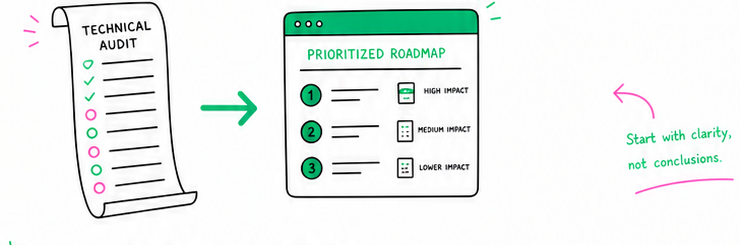
An audit is evidence, not strategy
An audit shows what is happening. It does not tell you what to do. Lists of issues without context lead to noise, debate, and no action.
Use the audit to understand the landscape, then build a plan. The value begins when technical evidence becomes a shared view of risk, opportunity, and the decisions ahead.
Translate issues into consequences
Every issue has an effect. Make it visible. How does it affect users, revenue, efficiency, or risk? What is the cost of doing nothing?
This is how you move from technical to strategic. A duplicate canonical tag is not a priority because a crawler labeled it. It becomes a priority when you can explain which pages it affects and what that prevents the business from achieving.
Group problems by root cause
Do not prioritize symptoms. Find the underlying causes. Cluster issues so you can solve problems once, not one page at a time.
A template defect may produce thousands of warnings. A workflow gap may allow the same problem to return after every release. Root-cause groups reduce duplicated effort and make ownership easier to assign.
Prioritize impact, confidence, and effort
Use three lenses: impact on the business, confidence in the diagnosis, and effort to fix. Focus on work that moves the needle without creating new risk.
Be explicit about uncertainty. A high-impact hypothesis with weak evidence may deserve a small validation step before a large build. A modest fix with high confidence and low effort may belong at the front of the queue.
Turn findings into ownership
Assign owners, align with other teams, and make dependencies explicit. Clear ownership creates momentum and accountability. Without it, even the best roadmap stalls.
Ownership includes the next decision, not only the eventual implementation. Name who will validate the issue, who can approve the tradeoff, and who confirms the outcome after release.
The roadmap is the real deliverable
The goal is not to finish the audit—it is to drive outcomes. A good roadmap is simple, visible, and reviewed regularly. It adapts as the business and site evolve.
Move each finding through a practical sequence: evidence, business impact, priority, owner, and next action. That is the point where an audit stops being a document and starts becoming useful work.
A useful audit makes the next decision easier.