Helpful Content Isn’t a Checklist
Why usefulness beats tricks—and how teams can build a repeatable standard for genuinely helpful pages.
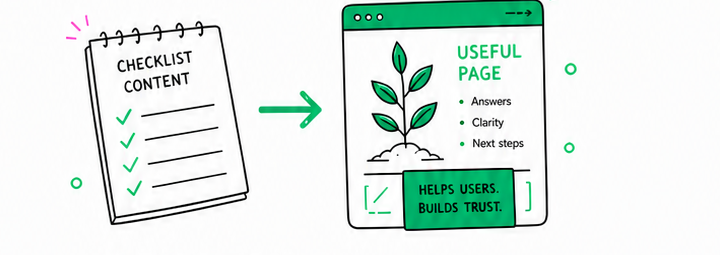
The checklist problem
Checklists feel productive. They give us something to tick off and reports to share. But when usefulness is reduced to a list, pages start to look right while failing real people.
The internet does not need more pages that technically exist. It needs pages that clearly help. A checklist can remind a team of basic hygiene, but it cannot decide whether an answer is honest, specific, and useful in the reader’s situation.
Useful to whom?
A helpful page starts with a clear reader in mind. Not “everyone.” Not “our audience.” Name the person, understand their situation, and define the job they are trying to get done.
Ask what they already know, what uncertainty brought them here, and what would allow them to move forward with confidence. If we cannot describe who we are helping, we cannot judge whether the page actually helps.
A better standard for helpful content
Helpful content is not about perfection. It is about usefulness. Pages should answer real questions, add clarity, and make the next step obvious.
That standard should be easy enough for writers, editors, subject-matter experts, and stakeholders to apply together. It should reward first-hand knowledge and clear decisions rather than length, keyword density, or the number of boxes completed.
Five questions worth asking
- Does it answer a real question? Start with the reader’s question, not the shape of the company outline.
- Does it add first-hand clarity? Share insights, examples, or experience the reader cannot get everywhere.
- Is the next step obvious? Leave readers knowing exactly what to do, try, or explore next.
- Can readers trust it? Be accurate, transparent, and up to date. Trust turns visits into loyalty.
- Would we publish it without search traffic? If the answer is no, it is probably not truly helpful.
The questions work best as prompts for judgment, not another scorecard. Use them to improve a draft, uncover weak assumptions, and create a shared language for editorial quality.
Build the habit, not the score
Make usefulness a team habit. Review real pages, talk to real users, and keep raising the bar. Tools can measure signals, but only people can measure help.
The strongest standard develops through repetition: choose a reader, understand the problem, publish a clear answer, watch what happens, and improve the page when the evidence changes.
Helpful content is a judgment practiced consistently—not a box checked once.