Search Intent Changes After the Click
Why the page experience must continue the promise made in search.
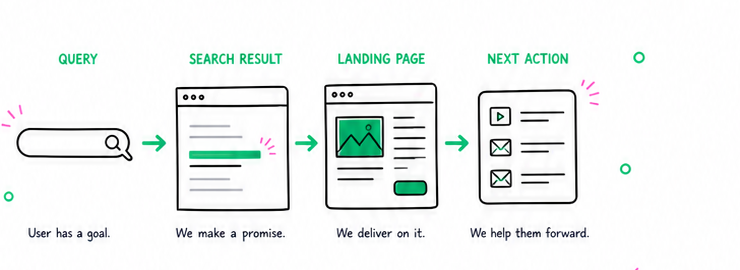
The click is only a handoff
Search results get the click. Your page keeps it. That handoff comes with expectations shaped by the query, snippet, and position. Honor that promise from the first moment.
A click is not proof that the search journey worked. It is permission to continue the conversation. The page still has to resolve uncertainty and show the visitor that they arrived in the right place.
Match the promise immediately
Surface the answer, outcome, or next step your result implied. Do not make people hunt for what they came for. Front-load clarity in the title, opening copy, and first useful visual.
Consistency matters more than repetition. The page does not need to copy the result word for word, but it should clearly deliver the same promise with greater depth.
Intent evolves on the page
People click with one intent and often discover another. As context increases, questions shift. Your page should adapt to help them go deeper, move laterally, or take action.
Someone beginning with a definition may soon need a comparison. A visitor evaluating an approach may discover an implementation constraint. Strong pages anticipate those natural changes without forcing every possibility into the opening screen.
Design the next useful step
Guide users to the most helpful move forward. Provide clear options that match their evolving intent—learn more, try, compare, contact, or act.
The next step should feel like part of the answer, not an interruption. Its label, placement, and level of commitment should make sense for what the visitor has learned so far.
Remove expectation gaps
Close the gaps between what was promised and what is delivered. Align titles, copy, visuals, and calls to action so nothing feels surprising or misleading.
Expectation gaps also appear when a page is technically correct but slow, difficult to scan, or vague about the next step. Search experience and page experience belong to one journey.
Continue the conversation
Keep listening after the click. Use content, cues, and feedback loops to support what comes next—and earn trust over time.
Watch the questions people ask next, the sections they return to, and the points where they leave. Those signals help the page keep its promise more completely.
The page must deliver the promise that earned the click.